

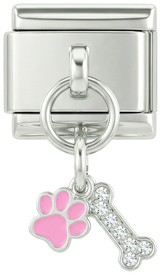
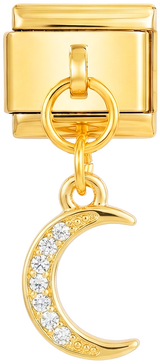
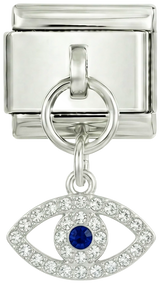


The Italian charm bracelet began in 1987, when a jewellery company in Sesto Fiorentino, near Florence, introduced a modular bracelet made of flat stainless steel links. Each link could be removed and replaced, so the wearer could build a bracelet that told their own story. Today, Italian link bracelets are worn around the world, but the idea behind them is far older than the 1980s.
This guide traces that story from ancient amulets to the Victorian era, through the Italian design that changed the format, the early 2000s boom and the revival that brought the bracelet back into fashion.
What Is an Italian Charm Bracelet?
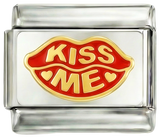
An Italian charm bracelet is a bracelet made of individual flat links, each carrying its own design, joined together so that links can be added, removed or swapped.
Unlike a traditional charm bracelet, where small ornaments dangle from a chain, the Italian style keeps every design flat against the wrist. The face of each charm is fixed onto the link itself, and the links connect to one another to form the band. A typical bracelet has around eighteen links, although the exact number depends on the size of the wrist. In the United States, the style is also widely known as a Nomination bracelet, after the company that introduced it.
Charms Long Before the Italian Bracelet
Charms are small symbolic ornaments, and people have worn them on the wrist for thousands of years.
In ancient Egypt, people wore amulets on the wrist and around the neck as far back as about 3000 BCE, believing they offered protection. During the Middle Ages, charms took on a different role and were used to show family origin as well as religious and political loyalties.
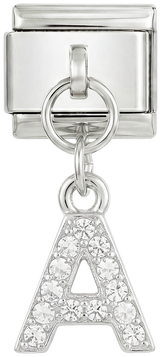
The charm bracelet as a fashion piece took shape in nineteenth-century England. Queen Victoria wore a gold chain hung with lockets holding portraits of her family, and her taste for sentimental jewellery spread through the upper classes of Europe. In 1889, Tiffany and Co. introduced a link bracelet with a single heart charm, which helped make the charm bracelet a familiar piece of everyday jewellery. These early bracelets shared one idea that still matters today: each charm marked a person, a memory or a milestone. Modern themed charms for zodiac signs, initials, travel and family follow exactly the same idea, only in a different format.
How the Italian Charm Bracelet Began in 1987
The modern Italian charm bracelet was created in 1987 by Paolo Gensini, a jeweller based in Sesto Fiorentino, Italy.
Gensini wanted a piece of jewellery that both men and women could wear and personalise. His solution was a modular stainless steel bracelet that held a series of removable charm links. He went on to found the jewellery company Nomination, which sold the design under the name Composable.
Stainless steel was an unusual choice for jewellery at the time, but it suited the concept. It was strong enough to hold the spring mechanism between links, resistant to everyday wear and affordable enough for people to collect links over time rather than buying one finished piece. That combination of durability and personalisation became the foundation of the whole style.
How the Modular Link Design Works
The modular link design is a system of identical links joined by a small spring, which lets each link open and close so charms can be swapped by hand.
Every link on the bracelet is the same size, so a plain link can be replaced with a decorated one at any point along the band. To change a link, you flex the bracelet to open the spring between two links, slide the old link out and clip the new one in. Some people use a small connecting tool, but fingers usually work just as well.
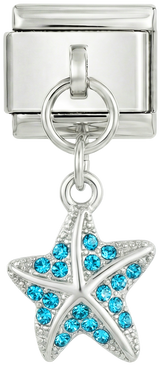
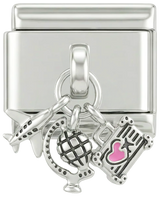
This is what makes the Italian style different from other charm jewellery. Instead of buying a finished bracelet, you start with a plain base and add charm links one at a time, choosing initials, zodiac signs, flags, animals or symbols that mean something to you. The bracelet grows and changes as your life does. The number of links depends on the size of your wrist, so check how many charms you need before you start replacing plain links.
The Early 2000s Boom
The early 2000s boom was the period, around the turn of the millennium, when Italian charm bracelets became a mainstream fashion trend.
The bracelet rose to wide popularity around the year 2000. It became a familiar sight in school playgrounds and shopping centres, and swapping links with friends was part of the appeal. Collecting charms gave people a reason to keep coming back, whether to mark a birthday, a holiday or a new friendship.
Many people who wore one at the time also remember the less glamorous side: the spring-loaded links had a habit of pinching arm hair. Like butterfly clips and plastic chokers from the same era, the bracelet fell out of fashion a few years later and was largely packed away.
Why the Italian Charm Bracelet Trend Returned
The Italian charm bracelet trend returned in 2023, when social media and television brought the style back to a new generation.
That year, contestant Anna-May Robey wore a stack of Italian charm bracelets on series nine of Love Island, and the style began trending on TikTok. People who had worn the bracelets as teenagers shared their old collections, and younger viewers discovered them for the first time.
Nostalgia for early 2000s fashion played a part, but the bracelet also suits how people like to dress now. It is personal, easy to update and simple to build slowly, which suits a generation that values self-expression and prefers pieces that can change with them rather than go out of date.
Why the Style Still Appeals Today
The Italian charm bracelet still appeals because it lets each wearer build a piece of jewellery that reflects their own life.
A finished bracelet can tell a story without a word being said. One link might mark a birth month, another a favourite city and another a pet or a close friend. Because links can be swapped, the same bracelet can look different from one season to the next, and it never has to feel finished.
The format also works across generations. People who wore the bracelet in the early 2000s often return to it with new charms, while younger wearers build their first one from scratch. Stainless steel bases remain popular for the same reasons they were chosen in 1987: they are durable, easy to care for and suited to daily wear.
Starting Your Own Charm Bracelet Collection
Starting a collection means choosing a base bracelet, deciding on a theme and adding links over time.
Begin with a base in silver, gold or rose gold. If you are buying for someone else, charm bracelet gift sets offer a ready-made starting point that the recipient can build on later.
Next, pick two or three charms that mark something important. Initials and birth signs are popular first choices because they are personal from day one. From there, add links for holidays, achievements and people you love. A bracelet that begins as a single gift often becomes a record of the years that follow, with each new link adding to the story.


Leave a comment